
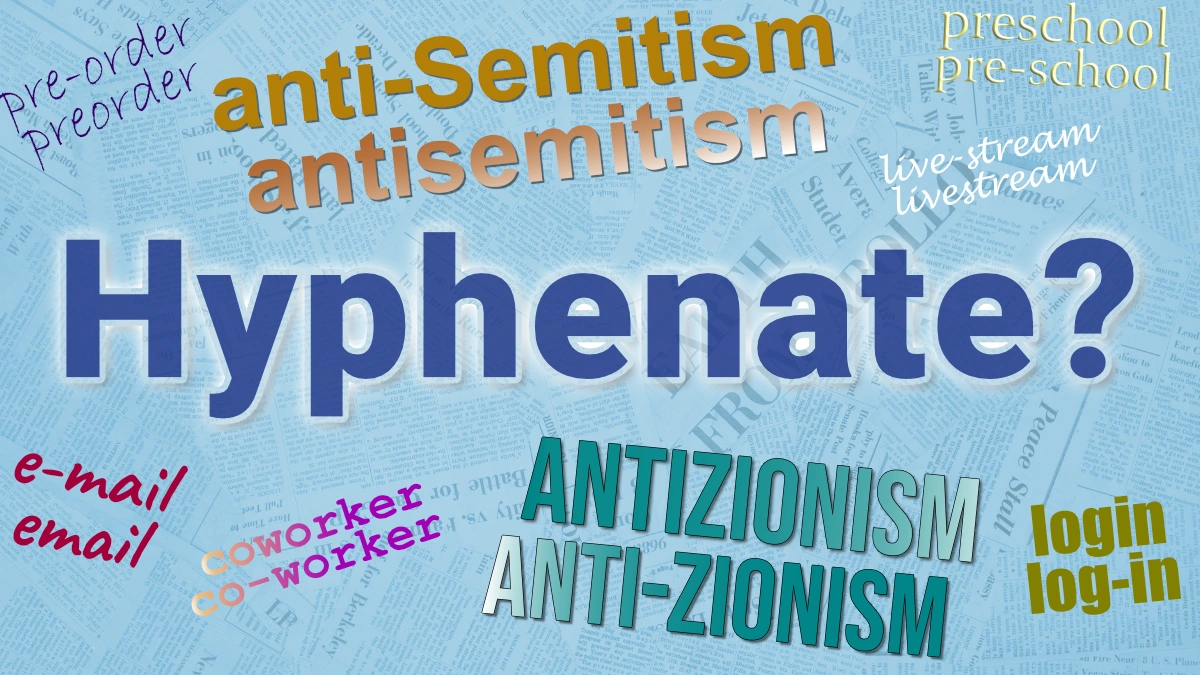
Below are some thoughts I recently posted on Facebook. They were prompted by the “hyphen issue” that has reappeared in the last year with the anti-antizionists’ (Adam Louis-Klein, Naya Lekht, and others) push to remove the hyphen from ‘anti-Zionism’. Many of their arguments for doing so mirror the arguments put forward in the 1980s for removing the hyphen from ‘anti-Semitism’. Indeed, the anti-antizionists often refer explicitly to those arguments in defending their own. This led me to take a look at those earlier arguments, and I found them to be rather weak. The post contains some brief, initial thoughts on this. I don’t discuss any implications for the anti-antizionists’ bid to remove the hyphen from ‘anti-Zionism’.
Posted on Facebook, August 17, 2026
I’ve been looking a bit at the arguments that were put forward, beginning in the late 1980s, for spelling ‘antisemitism’ without a hyphen. The same arguments have been repeated numerous times since then, with the result that the unhyphenated version has been adopted almost universally.
The thing is, the arguments, while I can understand their attraction, don’t actually work. The main one is that in order for the hyphenated version to be meaningful, there must exist “Semites” to be against. But since there aren’t, the hyphenated version is a misnomer and should be dropped.
But the hyphenated version didn’t mean “against Semites” any more than the unhyphenated one does. True, some people made the bad argument that Arabs can’t be antisemitic because they’re Semites too. And indeed this was another reason commonly put forward for dropping the hyphen, the idea being that dropping the hyphen would block that kind of mistake. But the mistake had nothing to do with the hyphen, as can be seen from the fact that people still make the mistake even when there’s no hyphen (e.g. Francesca Albanese a few months ago; and there are many other examples). The mistake is due to the word containing the letters s-e-m-i-t-e, and has nothing to do with whether there’s a hyphen or not.
Don’t get me wrong, I’m not suggesting that the hyphenated version is preferable. I much prefer the unhyphenated version. But it’s for the same reason I prefer ’email’ over ‘e-mail’, or ‘preschool’ over ‘pre-school’, etc. The unhyphenated versions are simply easier to write. But just as ’email’ means the same as ‘e-mail’, the unhyphenated ‘antisemitism’ means the same as ‘anti-Semitism’.
People arguing for dropping the hyphen would often insist that the hyphen suggests this or that, or that the capital ‘S’ “validates Wilhelm Marr’s discredited 19th-century racial theory” (or something like that). But hyphens and capital letters don’t have special powers to mean or suggest things, independently of the meanings a language community gives them. To the vast majority of people who have fully understood and competently used the term ‘anti-Semitism’, nothing about Semitic Languages or Wilhelm Marr or anything of the sort has ever been “suggested,” or judged to be at all relevant to the word’s meaning.